আপডেটঃ ২০২৬-১০-১৯ ০৮:৪৭:২৪
The Brahma: The Giant Chicken Whose Story Leads Back to Chittagong
Mohammed
Mahmuduzzman
It was once called the King of Chickens. But behind the Brahma’s enormous frame and feathered feet lies a story of ports, rivers and a forgotten connection to Bengal.
A chicken walks into a yard and immediately commands attention.
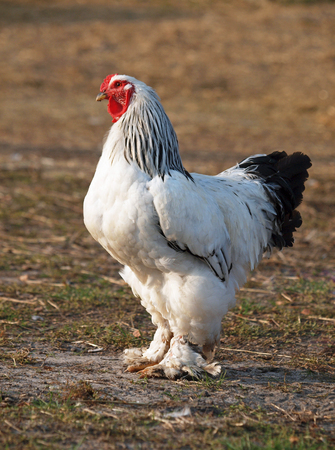
It is enormous, heavily feathered and almost theatrical in its appearance. Its legs disappear beneath a thick covering of feathers; its broad body sits low and solid, while its small head gives it an oddly dignified, almost aristocratic look.
This is the Brahma.
Once known as the ‘King of Chickens’, the breed became famous for its remarkable size and striking appearance. Yet its greatest curiosity may have little to do with its size.
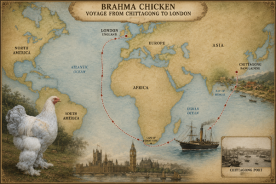
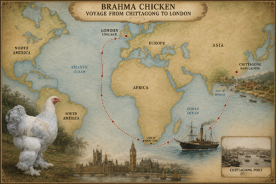
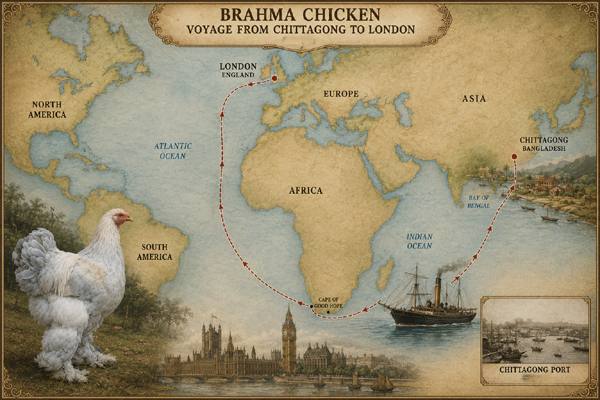
The story of the Brahma is also a story of Chittagong, the Brahmaputra and Bengal – a story that travelled across Asia, crossed the oceans and eventually became part of the history of American and European poultry breeding.
Today, the Brahma is generally described as an American breed. But that simple description conceals a more complicated past.
The Brahma: The King of
Chickens
For more than a century, breeders and historians have debated where the breed actually came from and which Asian chickens contributed to its ancestry.
The commonly told story begins in the 1840s, when large, heavily feathered chickens arrived in America from the Chinese port of Shanghai.
But there was another important strand to the story.
Chickens of the Grey Chittagong type, associated with the Chittagong region of eastern Bengal, are also believed to have contributed to the development of the Brahma.
That possibility helps explain why the Chicken once appeared under several different names, including Chittagong, Grey Chittagong, Shanghai and Brahmapootra.
In other words, the name of Chittagong found its way into the history of one of the world's most recognizable chicken breeds for a reason.
A journey from Bengal
The origins of the Brahma were already being debated in the 19th century.
One account suggested that large chickens were brought directly from Bengal to America. Another proposed that large Chickens arriving from Shanghai were crossed with Malay-type chickens from the Chittagong region, eventually producing the breed that became known as the Brahma.
Then there is the curious reference to Luckipoor.
An old historical account describes a place by that name near the Brahmaputra river route and claims that chickens resembling the ancestors of the Brahma were transported by ship from the area to America.
The reference appears to point to Lakshmipur, a place in the eastern Bengal landscape.
Such accounts are difficult to separate from the uncertainties and assumptions of 19th-century breed history. Yet they add another piece to a puzzle whose origins were never entirely clear.
Historical descriptions also point to physical characteristics that may connect the Brahma with the chickens of Chittagong.
The broad shape of the head, the small pea comb and the slightly projecting brow above the eyes have all been associated in breed histories with the Grey Chittagong.
For Bangladesh, this is more than an interesting footnote.
A breed now kept mainly as a fancy and exhibition Chicken in many parts of the world may carry within its history a connection to a region that is now part of Bangladesh.
The year Brahma found its name
By the middle of the 19th century, America had developed a fascination with large Asian chickens.
But there was a problem: nobody seemed entirely sure what to call them.
The names Shanghai, Chittagong and Brahmapootra were all in circulation.
Then, in 1852, breeders in Boston settled on the name Brahmapootra.
It was later shortened to the name the world knows today:
Brahma.
The name itself was a geographical clue, evoking the Brahmaputra, one of the great rivers of Bengal.
The story did not stop in America.
In the same year, Brahmas reached Britain. From there they spread through Europe, becoming one of the best-known large Asian chicken breeds.
The Chicken had crossed borders and oceans, but a name from Bengal travelled with it.
A giant among
chickens
The Brahma's physical presence is difficult to exaggerate.
Its body is broad, full and deep, while dense plumage makes it appear even larger. Its back is relatively short and slopes gently towards a short but well-spread tail.
Seen from behind, the tail has been compared with the shape of a horse's hoof, rather than the more familiar V-shaped tail of many chickens.
The wings are held close to the body. The neck is comparatively short and heavily feathered.
And then there is the head.
Small in proportion to the enormous body, it gives the Brahma an unusual sense of balance. The result is a Chicken that looks both powerful and strangely refined.
There is almost something regal about it.
Perhaps that is why the old title – King of Chickens – seems less like an exaggeration than it might first appear.
The face, the
comb and the feathered feet
The Brahma has a broad skull and a slightly projecting area above the eyes, creating a distinctive brow-like appearance.
Its comb is small and shaped like a series of peas, giving it the name pea comb. Three low ridges run along its length.
The wattles are relatively small, and beneath the neck there may be a feathered fold of skin known as a dewlap.
But the most memorable feature is perhaps lower down.
The yellow legs and toes are covered with feathers. They look large, soft and almost flowing beneath the Chicken's body.
Those feathered feet are more than decorative. They are one of the features that make the Brahma immediately recognizable.
It is difficult to look at one without noticing the feet first.
Not just a giant
chicken
The Brahma's appeal is not limited to its size.
The breed has developed into a surprisingly colourful family of varieties. Depending on the country and its breed standards, recognized colours and patterns include Light, Dark, Buff, Columbian, Buff Columbian, Partridge, Silver Partridge, Blue Partridge, Cuckoo, Birchen, White, Black and Self Blue, among others.
The result is a breed capable of looking dramatically different from one Chicken to another while retaining its characteristic massive frame.
But size and colour tell only part of the story.
The more interesting question is where that story began.
The Chittagong connection
For Bangladesh, the significance of the Brahma lies primarily in the Chittagong connection.
Historical sources refer to chickens known as Grey Chittagong, associated with the Chittagong region of present-day Bangladesh. Modern breed histories suggest that chickens of this type may have contributed to the Brahma's ancestry.
The historical importance of Chittagong makes the connection particularly plausible in a broader sense.
For centuries, Chittagong was one of Bengal's important maritime gateways. Ships carried goods and agricultural products from the region to distant markets, connecting Bengal with wider networks of trade across the Bay of Bengal and beyond.
By the medieval period, Chittagong had become one of the major ports of Bengal.
Animals, crops, commodities and people moved through such ports. So did ideas, technologies and, potentially, livestock breeds.
The history of a chicken, in other words, can sometimes tell us something about the history of a port.
An alternative view from Chittagong

A K Shamsuddin Khan
There is, however, another perspective on the question of origin.
A K Shamsuddin Khan, a member of Chittagong's prominent A K Khan business family, says he obtained a copy of The Complete Encyclopedia of Chickens from a bookshop in London.
According to him, the encyclopedia clearly identifies India as the ‘country of origin’ of the Brahma chicken.
There is an important historical qualification here.
In 1852, Bengal was part of British India. Describing the breed's country of origin as India would therefore reflect the political geography of the period rather than the modern boundaries of Bangladesh.
The same encyclopedia, he says, also refers to Lakshmipur, close to Chittagong and the Brahmaputra.
That detail adds another layer to an already complicated history.
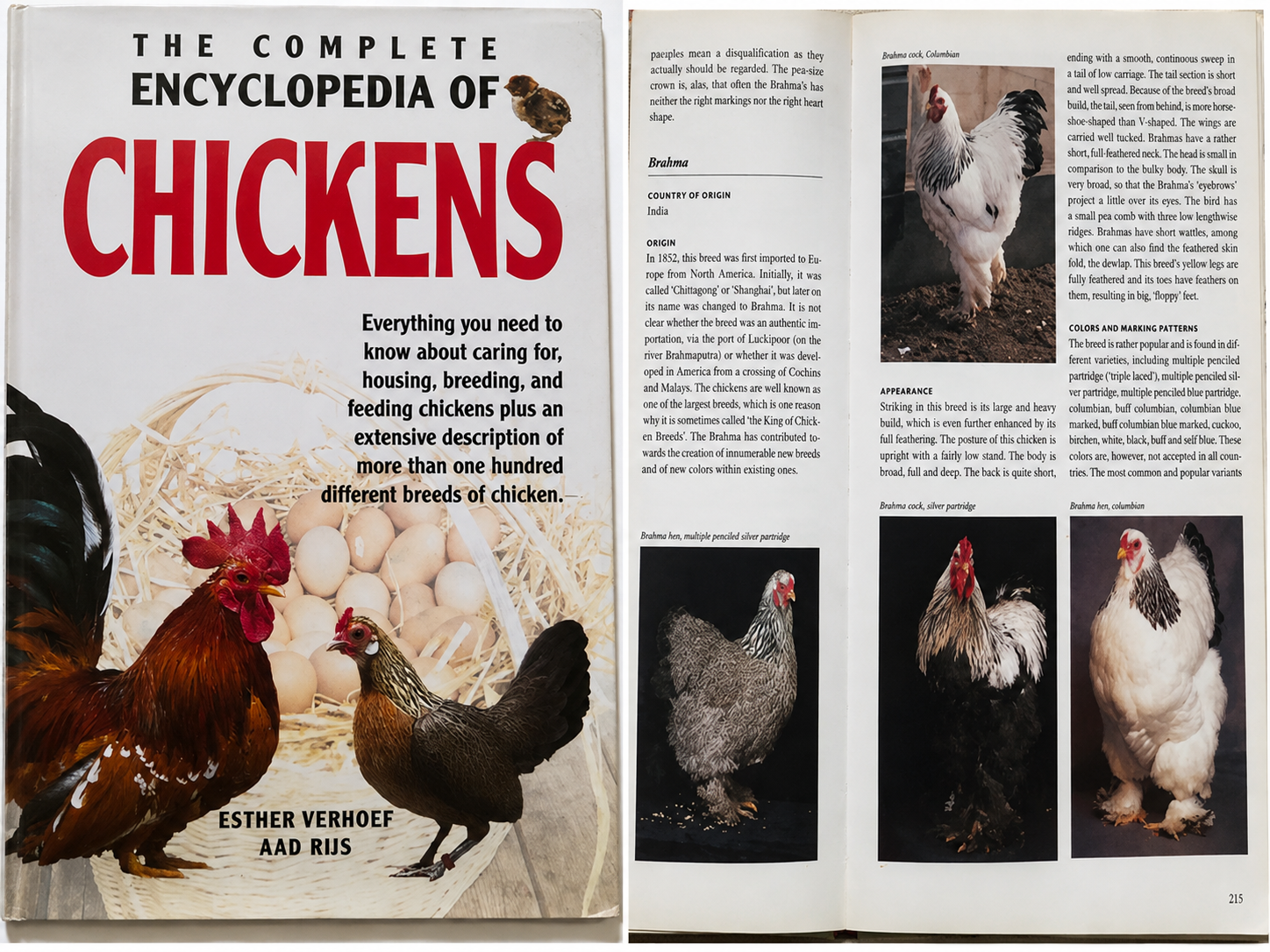
The Complete Encyclopedia of Chickens identifies Chittagong and Lakshmipur as the original places of origin of the Brahma chicken
The question is not simply whether the Brahma is ‘American’ or ‘Asian’. It is whether the story of its ancestry can be traced through several places and populations before the breed acquired its modern identity.
A Chicken that crossed oceans
The Brahma that exists today is unquestionably a distinct breed.
Generations of selective breeding in America, Britain and elsewhere have shaped its size, appearance and characteristics. The modern Brahma belongs firmly to the history of organised poultry breeding in the West.
But breeds have memories.
Sometimes those memories survive in names.
Chittagong.
Brahmapootra.
Shanghai.
They are traces of a journey that began long before the modern Brahma was standardised.
The Chicken that became the ‘King of Chickens’ travelled from Asia to America, crossed into Britain and spread across Europe. Along the way, its identity was reshaped by breeders and its history became increasingly difficult to disentangle.
Yet the old geographical names remain.
And that is what makes the Brahma particularly fascinating from a Bangladeshi perspective.
Behind the giant body, the elaborate plumage and the feathered feet lies a much older story – one that connects Bengal's livestock heritage with Chittagong's maritime history and the global rise of modern poultry breeding.
The Brahma may have become famous far from Bengal.
But somewhere in the history of this extraordinary Chicken, the name Chittagong still remains.
And sometimes, a name is enough to make us look again at where a story really began.
About the
Author
Mohammed Mahmuduzzaman
Editor and Publisher, Biporit Srot
Associate Fellow, Royal Historical Society
ক্যাটেগরিঃ জীবনধারা, কৃষি ও প্রকৃতি,

মোহাম্মদ মাহমুদুজ্জামান
সম্পাদক, বিপরীত স্রোত। সাংবাদিক ও গবেষক। অ্যাসোসিয়েট ফেলো, রয়াল হিস্টোরিকাল সোসাইটি।